 India
India
 World
World
 Entertainment
 Sports
 Chhattisgarh
 Haryana
 Delhi
Delhi
 Religious
 Business
 Tech & Auto
 Education
 Health
 Andhra Pradesh
 Telangana
 Sikkim
 Odisha
 Jharkhand
 Assam
Assam
 Nagaland
Pakistan was shaken by Brahmos and Crystal Maze missiles
New revelations of Operation Sindoor are shocking
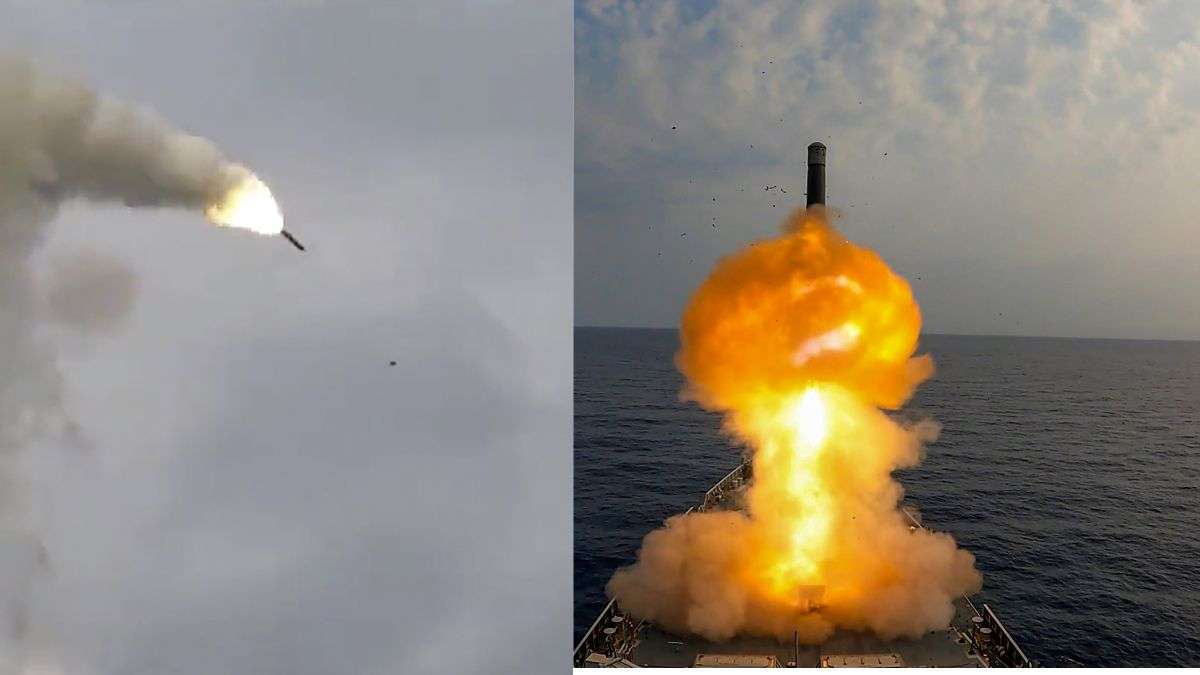
India launched a strong counter-attack on Pakistan's terrorist bases under Operation Sindoor on 7 May 2025. This mission was based on a precise, well-planned and digital strategy, in which deep coordination was seen between the Indian Air Force, Army and intelligence agencies.
Under the operation, the bases of terrorist organizations like Lashkar-e-Taiba and Jaish-e-Mohammed located in Pakistan and Pakistan Occupied Kashmir (PoK) were completely destroyed. During this, the Indian Army not only destroyed the terrorist bases, but also destroyed Pakistan's air defense system, which dealt a major blow to its military balance.
These missiles were used in the air strike
In the operation, Pakistan's strategic structure was weakened and its defense system was crippled by using long range missile strikes. According to sources, six SCALP subsonic cruise missiles were used in this operation, through which the strong bunkers of Jaish-e-Mohammed were destroyed by targeting them with precision.
Rafale aircraft played an important role
These missiles are capable of attacking the target accurately by evading the enemy's radar and making deep penetration. According to defense sources, India used 19 BrahMos cruise missiles during the entire operation. In this four-day operation, India used modern and multi-layer weapon systems. India's most modern Rafale fighter aircraft played an important role in this entire operation.
Precise attacks on targets in Pakistan
Rafale aircraft demonstrated their superior avionics, long range stand-off weaponry and electronic warfare capabilities. In Operation Sindoor, the Indian Air Force used state-of-the-art fighter aircraft like Rafale and SU-30MKI. Equipped with SCALP and BrahMos cruise missiles, these aircraft carried out precise attacks on various targets in Pakistan.
Specifically, the Jaish-e-Mohammed headquarters in Bahawalpur, Pakistan, the Lashkar-e-Taiba training centre in Muridke, and the Sarjal camp in Sialkot were targeted. These attacks destroyed nine major terrorist hideouts in Pakistan, killing more than 100 terrorists.
Pakistan's response and India's retaliation
Pakistan launched drone and missile attacks to target Indian aircraft in its airspace in response to Operation Sindoor. However, Indian S-400 air defense systems and other counter-UAV technologies foiled these attacks. Subsequently, India destroyed the Chinese-made HQ-9 missile defense system located near Lahore, giving a clear message to Pakistan that its every move would be responded to.
Operation success and Pakistan's defeat
Operation Sindoor thwarted the plans of Pakistan's military chief General Asim Munir. Pakistan had launched its Operation 'Bunyan al-Marsoos', claiming to destroy the Indian Air Force in 48 hours. But the operation ended in just 9 hours after Indian attacks. This forced Pakistan to demand a ceasefire.
Operation Sindoor proved that India is capable of taking action against terrorism beyond its borders. This operation sent a message to Pakistan that India can go to any extent for its security and sovereignty. This operation has become a symbol of Indian military strategy and technical capability.