
 India
India
 World
World
 Entertainment
 Sports
 Chhattisgarh
 Haryana
 Delhi
Delhi
 Religious
 Business
 Tech & Auto
 Education
 Health
 Andhra Pradesh
 Telangana
 Sikkim
 Odisha
 Jharkhand
 Assam
Assam
 Nagaland
India’s Diplomatic Push at BRICS Summit
From Terrorism to Trade, Members Present a Common Stand
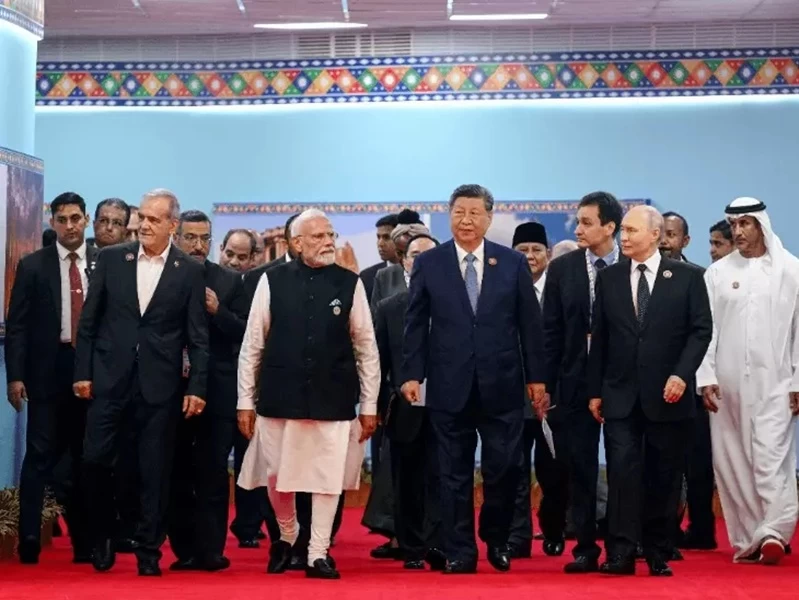
New Delhi: The first day of the 18th BRICS Summit in New Delhi witnessed a series of significant developments spanning diplomacy, global politics and economic cooperation. Prime Minister Narendra Modi held bilateral meetings with Chinese President Xi Jinping, Russian President Vladimir Putin and Iranian President Masoud Pezeshkian. Meanwhile, BRICS countries approved the 140-point New Delhi Declaration, presenting a common position on issues including terrorism, the Pahalgam attack, the West Asia crisis, trade, unilateral sanctions, transactions in local currencies and reforms of the United Nations.
Modi-Xi Meeting: Focus on Preventing Differences from Turning into Disputes
On the sidelines of the BRICS Summit, Prime Minister Narendra Modi held an important bilateral meeting with Chinese President Xi Jinping. The meeting, which took place during Xi’s visit to India after nearly seven years, attracted considerable international attention. Both leaders emphasized the need to take India-China relations forward from a long-term and strategic perspective. Prime Minister Modi said that differences between the two countries were natural, but they should not be allowed to turn into disputes. Peace and stability along the border were described as essential for further progress in bilateral relations. The two sides also discussed trade, trade imbalance, supply chains, people-to-people contacts and border-related issues.
Xi Jinping said India and China could benefit from each other’s capabilities and experiences while pursuing shared development. He also called for stronger cooperation between the two countries within the BRICS framework. The meeting came at a time when India and China have been working to reduce tensions along the border and improve bilateral relations.
Modi-Putin Talks: $100 Billion Bilateral Trade Target by 2030
Prime Minister Narendra Modi also held detailed talks with Russian President Vladimir Putin. The discussions covered the Russia-Ukraine conflict, the situation in West Asia and the impact of ongoing developments on maritime routes. India reiterated that dialogue and diplomacy should remain the preferred means of resolving conflicts. The safety of Indian sailors also emerged as an important concern. Amid the Russia-Ukraine conflict, the safety of Indian sailors in the Black Sea region has remained a matter of concern for New Delhi.
The two leaders also discussed ways to strengthen economic ties. India and Russia agreed to work towards increasing bilateral trade to $100 billion by 2030. Putin also invited Prime Minister Modi to visit Russia.
Modi-Putin Ride in One Car Draws Attention
A photograph of Prime Minister Narendra Modi and President Putin travelling together in the same car during the BRICS Summit also attracted attention. The two leaders travelled together to the BRICS Business Forum programme at Bharat Mandapam. The image was viewed as significant against the backdrop of continuing global tensions and the close relationship between India and Russia.
Prime Minister Modi also presented Putin with a Russian translation of the famous work Thirukkural by Tamil saint and poet Thiruvalluvar. Modi expressed hope that the translation would contribute to strengthening people-to-people ties and mutual understanding between the two countries.
Modi Meets Iranian President Pezeshkian
Prime Minister Narendra Modi also held a bilateral meeting with Iranian President Masoud Pezeshkian. The two leaders discussed India-Iran relations, cooperation within BRICS and the ongoing conflict in West Asia. India once again stressed the importance of resolving disputes through dialogue and diplomacy.
Maritime security, trade and the safety of sailors were also part of the discussions. These issues are particularly important for India given the impact of the conflict in West Asia on maritime trade and energy supplies.
New Delhi Declaration Sends Strong Message on Terrorism
One of the most significant diplomatic outcomes of the first day was the adoption of the 140-point New Delhi Declaration. The nearly 45-page document records the BRICS countries’ common positions on terrorism, global trade, West Asia, energy, finance and reforms of the United Nations, among other issues.
The declaration strongly condemned terrorism in all its forms and manifestations. BRICS members reiterated their commitment to tackling challenges such as cross-border terrorism, terror financing and the provision of safe havens to terrorists.
The declaration also explicitly condemned the terrorist attack in Pahalgam on April 22, 2025. The attack claimed the lives of 26 people. BRICS members reiterated their commitment to zero tolerance towards terrorism and stressed the need to ensure accountability for terrorists and their supporters.
BRICS Calls for Restraint and Diplomacy in West Asia
The New Delhi Declaration expressed serious concern over the continuing violence and tensions in West Asia. Member countries called on all parties to exercise maximum restraint and urged that disputes be resolved through dialogue, consultation and diplomacy.
The declaration also emphasized the continuation of humanitarian assistance in Gaza and the protection of civilians. BRICS reiterated its support for a two-state solution based on the 1967 borders, involving the establishment of a Palestinian state. The declaration condemned unilateral military action, although it did not name any particular country.
Xi Jinping also expressed concern over the ongoing war in West Asia during the BRICS proceedings.
BRICS Opposes Unilateral Sanctions and Tariff Barriers
The New Delhi Declaration expressed concern over unilateral economic sanctions and other measures imposed on countries, noting that such steps could affect development, food security and healthcare services.
BRICS also raised concerns over unilateral tariffs and non-tariff barriers. Member countries supported strengthening a multilateral trading system based on World Trade Organization rules. The grouping therefore sent a clear message on the need to protect international trade from unilateral economic pressure and sanctions.
Focus on Local Currencies Instead of a Common BRICS Currency
BRICS countries also emphasized increasing the use of local currencies for trade and payments among member states. The objective is to make cross-border payments faster, cheaper, safer and more convenient.
However, no announcement was made regarding the creation of a common BRICS currency. Instead, the focus remained on improving trade and payment mechanisms using the respective national currencies of member countries.
The BRICS Payment Task Force is exploring possibilities for linking payment and messaging systems across different countries. The initiative aims to make trade and investment among member states easier.
UN Security Council Reform and Greater Role for India and Global South
BRICS countries backed the need for comprehensive reforms of the United Nations Security Council. The declaration highlighted the need to provide developing countries with greater representation in global decision-making processes.
It also referred to support from China and Russia for the aspirations of India and Brazil to play a larger role at the United Nations. India has long been demanding comprehensive UN reforms, including permanent membership of the Security Council.
Prime Minister Modi also pointed out that the Global South faces many of the world’s major challenges but does not yet have adequate representation in global decision-making.
India Pushes for Greater Global South Participation in AI, Cyber Space and Space
Artificial intelligence, or AI, was another important issue on the BRICS agenda. The declaration emphasized the development of safe, reliable, inclusive and responsible AI while taking into account the needs of the Global South.
India also raised the issue of equal participation by developing countries in AI, cyberspace, space, biotechnology and other critical technologies. India emphasized that these technologies are not merely creating economic opportunities but are also shaping the rules that will govern the global future.
India’s Digital and Health Initiatives Receive Support
The New Delhi Declaration also acknowledged several initiatives proposed by India. BRICS countries agreed to work towards sharing and expanding the use of digital public infrastructure among member states.
In the health sector, initiatives were discussed to develop networks of training institutions and centres of excellence focused on mental health. The establishment of a BRICS Industrial Competitiveness Centre in India was also welcomed. The centre is intended to help small businesses and the manufacturing sector adopt new technologies.
Work will also continue towards developing a BRICS and New Development Bank knowledge platform for sharing development experiences.
Business Forum Focuses on Trade, Investment and Technology
Trade, investment, technology and economic cooperation were major areas of discussion at the BRICS Business Forum. Prime Minister Modi noted that the expanded BRICS grouping represents nearly half of the world’s population and has a significant share of the global economy and trade.
India emphasized that BRICS should not remain limited to political discussions but should become an effective platform for practical economic cooperation. Areas such as agriculture, energy, healthcare, technology, small businesses, infrastructure and investment were identified for greater cooperation.
New Initiatives Cover Agriculture, Urban Development and Employment
Under India’s BRICS presidency, several proposals were put forward to strengthen cooperation in agriculture. These included centres of excellence focused on sustainable and natural farming, a digital agriculture network and greater use of technology in agriculture.
In urban development, discussions focused on advancing cooperation through the BRICS Urban Mobility Hub and climate-resilient infrastructure. Programmes related to employment, skill development, women’s participation and youth cooperation also remained important elements of India’s BRICS agenda.
Gala Dinner Showcases Indian Culture
The first day of the summit concluded with a gala dinner hosted by Prime Minister Narendra Modi at Bharat Mandapam. Leaders of BRICS member countries attended the event.
Guests were served Indian cuisine, including dishes prepared from Shree Anna, or millets. Amid formal meetings and discussions on serious global issues, the dinner provided an opportunity for informal interaction among the leaders and offered them a glimpse of Indian culture and cuisine.
Banyan Plantation Carries Message of Unity and Sustainability
During the summit, BRICS leaders also planted a banyan sapling. The tree’s strong roots and widespread branches were seen as symbols of continuity, strength and interconnectedness.
India’s 2026 BRICS presidency is focused on resilience, innovation, cooperation and sustainable development. The plantation was therefore viewed as reflecting the broader spirit and objectives of the summit.
China to Host 19th BRICS Summit in 2027
The next BRICS presidency and summit host were also formally indicated on the first day. China will assume the BRICS chairmanship in 2027 and host the 19th BRICS Summit.
Xi Jinping said China would work with BRICS countries to contribute towards peace and stability in West Asia and the Gulf region.
Key Takeaways from the First Day
The developments on the first day of the New Delhi Summit highlighted India’s efforts to maintain dialogue with China despite longstanding differences, while simultaneously strengthening its strategic partnerships with Russia and Iran. On major international conflicts, including the Russia-Ukraine war and the West Asia crisis, India continued to emphasize dialogue and diplomacy.
At the same time, BRICS sought to develop a collective position on terrorism, trade, unilateral sanctions, local-currency transactions, artificial intelligence and reforms of global institutions.
The New Delhi Declaration also demonstrated that although the interests of the expanded BRICS membership may differ on several issues, member countries are attempting to build common ground on broader concerns such as terrorism, economic cooperation, technology, healthcare, agriculture and global governance. During its presidency, India has sought to take BRICS cooperation beyond political statements and connect it with practical initiatives in trade, technology, health, agriculture and development.