 India
India
 World
World
 Entertainment
 Sports
 Chhattisgarh
 Haryana
 Delhi
Delhi
 Religious
 Business
 Tech & Auto
 Education
 Health
 Andhra Pradesh
 Telangana
 Sikkim
 Odisha
 Jharkhand
 Assam
Assam
 Nagaland
Another big success of ISRO, EOS-08 launched
Know the full details of the mission
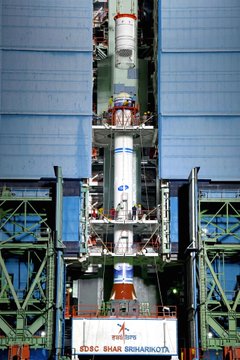
The Indian Space Research Organization (ISRO) has got another big success today. The Small Satellite Launch Vehicle (Small Satellite Launch Vehicle-D3) SSLV-D3 launched Earth Observation Satellite-8 (EOS-08) from Satish Dhawan Space Center in Sriharikota. This is after the second successful launch of the second test flight of Small Satellite Launch Vehicle (SSLV-D2-EOS-07) in February 2023.
Not even a small mistake was made in the launch - ISRO
After the successful launch, ISRO said that with the help of SSLV-D3 rocket, the EOS-08 satellite has been successfully placed in orbit. Like the other missions of SSLV, today's mission has also been a textbook mission. Not even a small mistake has been made.
This is ISRO's third mission
Today's mission is the third mission in 2024 for the Bengaluru-headquartered space agency after the successful launch of PSLV-C58/XpoSat in January and GSLV-F14/INSAT-3DS missions in February. ISRO said the six-and-a-half-hour countdown ahead of the launch of the SSLV-D3-EOS08 mission had begun at 02.47 pm IST.
Launched at 9:19 am
The smallest SSLV rocket, which is about 34 metres tall. It was planned to be launched on August 15 at 9.17 am and was later launched on August 16 at 9:19 am from the first launch pad of the Satish Dhawan Space Centre here.
The work is to design and develop a microsatellite
ISRO said one of the primary objectives of the SSLV-D3-EOS-08 mission is to design and develop a microsatellite. Also making payload equipment compatible with microsatellites and incorporating new technologies required for future operational satellites. With today's mission, ISRO has completed the developmental flight of the smallest rocket, which can carry satellites weighing up to 500 kg.
NewSpace India Limited will get a boost
It can also put them in low Earth orbit (500 km above Earth). This mission will also boost ISRO's commercial arm NewSpace India Limited, so that commercial launches can be done using such small satellite launch vehicles in collaboration with the industry.
Important role in disaster monitoring
The mission of the spacecraft is for one year. Its mass is about 175.5 kg. It generates power of about 420 watts. ISRO said that the satellite interfaces with the SSLV-D3 / IBL-358 launch vehicle. The first payload EOIR is designed to capture images in the mid-wave IR (MIR) and long-wave IR (LWIR) bands both during day and night. It is used for applications such as satellite-based surveillance, disaster monitoring, environmental monitoring, fire detection, volcanic activity observation and industrial and lightning disaster monitoring.
Will help in flood detection
The second GNSS-R payload demonstrates the ability to use GNSS-R-based remote sensing for applications such as ocean surface wind analysis, soil moisture estimation, cryosphere studies in the Himalayan region, flood detection and inland water body detection.