
 India
India
 World
World
 Entertainment
 Sports
 Chhattisgarh
 Haryana
 Delhi
Delhi
 Religious
 Business
 Tech & Auto
 Education
 Health
 Andhra Pradesh
 Telangana
 Sikkim
 Odisha
 Jharkhand
 Assam
Assam
 Nagaland
VB G-RAM-G Implemented: 125 Days of Work Instead of 100
Monitoring via AI and GPS; Workers' Incomes to Rise
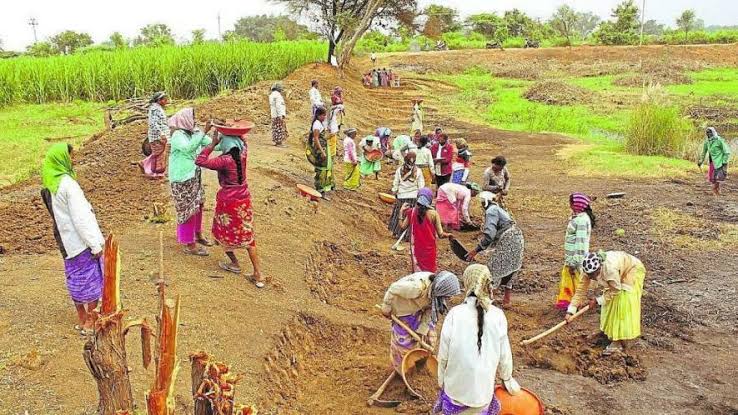
New Delhi, Claiming major changes to rural employment schemes, the Central Government has announced the nationwide implementation of the ‘Viksit Bharat–Rozgar aur Aajivika Mission Guarantee (Rural) Act, 2025’—or VB G-RAM-G—replacing the Mahatma Gandhi National Rural Employment Guarantee Act (MGNREGA). Under this new system, the annual employment guarantee has been increased from 100 to 125 days, and the minimum daily wage has been raised to over ₹327.
The government states that this new scheme has been formulated with the goal of ‘Viksit Bharat 2047’ (Developed India 2047) in mind, aiming to provide a new direction to transparency, accountability, and rural development through the extensive use of modern technology.
MGNREGA: The UPA Government’s Ambitious Scheme
In 2004, the United Progressive Alliance (UPA) government, led by Dr. Manmohan Singh, implemented the National Rural Employment Guarantee Act (NREGA) with the aim of fostering rural employment and infrastructure development. The scheme sought to provide livelihood opportunities to rural families while simultaneously creating community assets such as ponds, wells, rural roads, and water conservation structures.
In 2009, it was renamed the Mahatma Gandhi National Rural Employment Guarantee Act (MGNREGA), a scheme the UPA government consistently highlighted as one of its key achievements.
VB G-RAM-G: A New Technology-Driven System
After nearly two decades, the government has now introduced a new system in the form of VB G-RAM-G. To ensure transparency and effective monitoring, the new scheme incorporates biometric authentication, GPS-based worksite monitoring, mobile technology, Artificial Intelligence (AI), and a real-time audit system. The government believes that the use of these technologies will enable effective control over fake job cards, erroneous payments, and other irregularities, while also facilitating real-time monitoring of project progress.
Guarantee of 125 days of employment instead of 100
Under the new scheme, a provision has been made to guarantee 125 days of employment annually to rural workers, whereas the limit under MGNREGA was 100 days. Additionally, the average daily wage has been raised from ₹298.80 to ₹327.40.
According to the Ministry of Rural Development, the new wage rates have come into effect across all states and Union Territories of the country starting July 1, 2026.
Increase in annual income
The provision of an additional 25 days of employment under the new system will lead to a significant rise in the workers' annual income. Previously, 100 days of employment yielded an income of approximately ₹29,880, whereas 125 days of work will now generate around ₹40,925. Consequently, due to the additional workdays and increased wages, an annual income hike of approximately ₹10,500 is projected.
Increased financial participation by states
The financial structure has also been modified under the new scheme. While the Central Government previously bore the entire cost of the labor component under MGNREGA—with a 75:25 ratio for material costs—the share of state governments has now been increased.
For Northeastern and Himalayan states, the expenditure-sharing ratio between the Centre and the states has been set at 90:10, whereas for other states and Union Territories with a legislative assembly, it will be 60:40. The Central Government will bear the entire cost for Union Territories that do not have a legislative assembly.
Scheme benefits unavailable during the agricultural season
Under the new system, state governments will declare the periods corresponding to the peak agricultural seasons for sowing and harvesting. Employment under the scheme cannot be demanded during these periods. The government argues that this will help ensure the availability of workers for agricultural activities.
The government claims that the 'Viksit Bharat – Employment and Livelihood Mission Guarantee (Rural)' scheme will play a pivotal role in imparting new momentum to the rural economy through technology-driven transparency, increased employment, and better wages.