
These challenges are tough in front of Chandrayaan-3
Former ISRO scientist told how difficult this journey is, what problems will come?
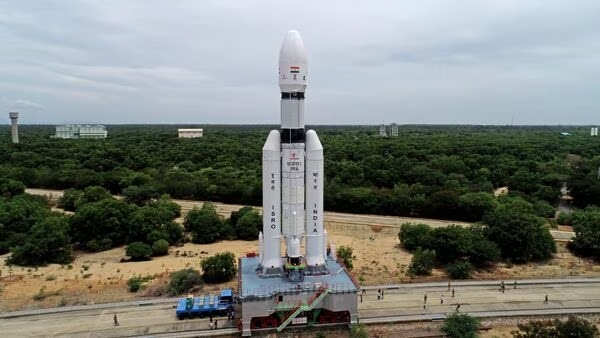
Indian scientists successfully launched Chandrayaan-3 from Sriharikota at 2.30 pm. The eyes of the whole world are focused on this mission. Chandrayaan-3 can land on that part of the moon (Shackleton Crater) where no mission of any country has reached so far. Chandrayaan-3 was launched from LVM3 rocket. In order to successfully land the lander on the lunar surface, many types of safety equipment have been installed in it.
Launching is successful. The whole country is proud of this. However, there are still many difficulties in the way of Chandrayaan. We are going to tell you about five such big challenges. For this we spoke to former ISRO scientist Vinod Kumar Srivastava. Vinod was an important member of the GSLV-F06 rocket launching team. Let's know what he told about Chandrayaan-3...
First know some special things related to Vinod Srivastava
This thing is of 25 December 2010. ISRO launched GSLV-F06 from Satish Dhawan Space Centre, Sriharikota. Everything was fine till 47.5 seconds after lifting off from the ground, but after that the direction of the rocket started changing. As soon as the flaw in the rocket was known, the command for the destruction of the rocket was given. Means the rocket had to be destroyed in the air itself. At that time the cost of that rocket was around Rs 325 crore. The command to demolish this was given by Vinod Kumar Srivastava only. At that time Vinod Satish Dhawan was the Range Safety Officer of the Space Center. Vinod Srivastava has worked with former President Dr. APJ Abdul Kalam in ISRO as well as DRDO.
Now know what needs to be done before launching a rocket
Vinod explains that before leaving a rocket, its path is fully studied. The details of all the areas falling in the middle of that route and the population there are prepared. After this, before the launch, the Hydrographic Office and the Civil Aviation Department in Delhi are told the path of the rocket. Both of these clear the path of the rocket. Means, if there is a route of a flight, helicopter somewhere in the air, then they change it. Overall the path is cleared for the rocket in the air. The district administration of the areas falling in the path of the rocket is informed an hour in advance. When he says OK, the rocket is launched. Oil rigs, oil tankers, ships etc. ply from Sriharikota to Andaman and Nicobar. They are also informed in time.
Successful launch done, but now what are the challenges to be tackled?
Vinod Srivastava says, 'Chandrayaan will face difficulties at every stage from launching to landing. ISRO has decided one of the most difficult stages of launching. Chandrayaan-3 has been successfully launched. Now it will revolve around the Earth's orbit.
Vinod explains that Chandrayaan-3 has two parts. The first propulsion module and the second lander module. The propulsion module weighs 2148 kg. It will take the lander and rover from injection orbit to 100×100 km lunar orbit. Its main function is to move the lander module from launch vehicle injection orbit to lander separation.
Now let's talk about the second part. This is the lander module. Means after reaching the moon's orbit, the process of landing on its surface starts. Both these processes are very difficult and there are many challenges in it.
1. Completion of the journey in the Earth's orbit at the right time: Chandrayaan-3 has now reached the Earth's orbit after being successfully launched from the Earth. Now for 22 days, it will revolve in the Earth's orbit and through maneuvers it will also increase the scope up to six orbits. Means by increasing the speed of Chandrayaan, it will be removed from the Earth's orbit. After this, it will be transferred from the Earth's orbit to the Moon's orbit. This is also a difficult process. Maintaining the prescribed distance and speed of Chandrayaan from the Earth is a big challenge. Any mistake in this can spoil the mission.
2. Maintaining the speed with time: To reach the moon, the rocket has to move at full speed, but when it reaches closer, then how to control that speed becomes a big challenge. When a rocket comes back to the earth, then the atmosphere there remains dense, so much friction is found that the speed of the rocket decreases. But on the contrary, the atmosphere remains on the moon, in such a situation how to reduce the speed is also a big challenge. There is a very thin atmosphere on the moon, in such a situation, low speed can be done there only with the help of propulsion system.
3. Going on the right route: There is no GPS in the space rocket. In such a situation, scientists do all the calculations through computers. This precise calculation matters even at the time of landing on the moon. If it goes wrong, the mission fails. A new record can be made only if it is correct.
4. Orbiting in the moon's orbit is also a challenge: After entering the moon's orbit, it will orbit for 13 days. After this, the lander will be separated from the propulsion module 100 km above the moon. This process is also very complicated. This is because during this time the scientists sitting in the space center cannot do anything. All this happens automatically based on pre-set data. Every second is challenging.
5. The biggest challenge of landing: Successfully landing the lander on the surface of the moon is the biggest challenge. This could not happen in Chandrayaan-2. Along with the safe landing, the process of separation of both the rovers present in the lander is also challenging. Input from the moon will be available only when the rover is separated. Meaning there will be a challenge to make the rover work properly after landing. The rover will land at an unknown place. The place of landing and the situation there will also matter a lot for this.