
 India
India
 World
World
 Entertainment
 Sports
 Chhattisgarh
 Haryana
 Delhi
Delhi
 Religious
 Business
 Tech & Auto
 Education
 Health
 Andhra Pradesh
 Telangana
 Sikkim
 Odisha
 Jharkhand
 Assam
Assam
 Nagaland
State-Level Workshop on Operation and Maintenance of Water Supply Schemes
Deputy Chief Minister Shri Saw Attended

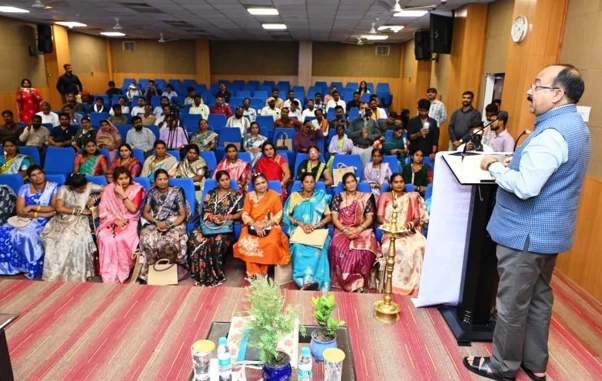
Bilaspur (Chhattisgarh), Deputy Chief Minister and Public Health Engineering Minister Shri Arun Saw today attended a state-level workshop on the operation and maintenance of rural pipeline water supply schemes for women Sarpanches from Har Ghar Jal certified villages under the Jal Jeevan Mission. Addressing the women Sarpanches at the workshop, held at the Rajiv Gandhi National Ground Water Training and Research Institute (RGNGWTRI) in Nava Raipur, he said that rainwater harvesting and water conservation are essential for the long-term smooth operation of water supply schemes. This will recharge groundwater and maintain water availability in water sources for the long term.
Deputy Chief Minister Shri Saw inquired from the Sarpanches at the workshop about the changes in the lives of villagers, especially women, after the provision of tap water to every household in the villages. He inquired about the arrangements made by the Panchayats for the operation and maintenance of the tap water schemes. He also inquired about the water sources in the villages, regular water quality testing, and maintenance fees. This one-day state-level workshop was organized by the Public Health Engineering Department in collaboration with UNICEF and ACE (Action for Community Development). Approximately 100 women Sarpanches participated.
The workshop included extensive discussions and in-depth discussions on the operation, maintenance, and repair of tap water schemes in Har Ghar Jal certified villages. Women Sarpanches shared their experiences of arranging water supply and operating and maintaining tap water schemes in their respective Panchayats under the Jal Jeevan Mission. Experts at the workshop shared tips for the successful, uninterrupted, and long-term operation of tap water schemes.
Deputy Chief Minister Shri Arun Sao said at the workshop that the care and careful use of water sources used for water supply is essential. The long-term success of the scheme depends on their sustainability. He added that after the completion of the tap water schemes and their transfer to the Panchayats, the Gram Panchayats will be responsible for their operation and maintenance. Jal Jeevan Mission is a scheme for our homes and our villages. Gram Panchayats, in collaboration with villagers, must make the water supply system self-sufficient. Mr. Saw emphasized the importance of maintaining water levels and recharging groundwater sources by constructing stop dams and storing rainwater. He said that all villages should make arrangements to fill ponds properly by removing encroachments and obstructions to the natural flow of rainwater.
Mr. Mohammad Qaiser Abdulhaq, Secretary of the Public Health Engineering Department, Ms. Ruby Mukherjee, Director of the Rajiv Gandhi National Ground Water Training and Research Institute, and Ms. Shweta Patnaik, Water and Sanitation Specialist of UNICEF, also addressed the workshop. Mr. K.K. Markam, Chief Engineer of the Public Health Engineering Department, and Mr. Sameer Gaur, Superintending Engineer, were also present at the workshop.