
Sengol handed over to PM Modi by Adhinam
will be installed in the new Parliament House
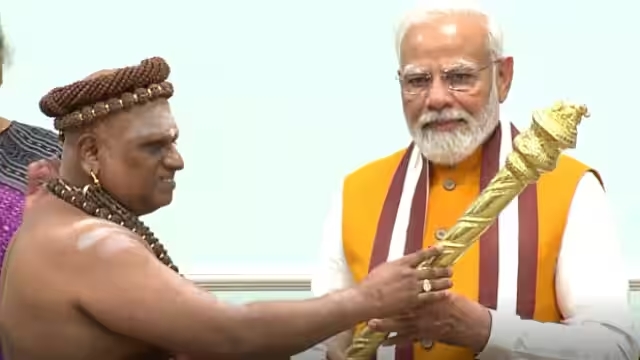
New Delhi, On Saturday evening, a day before the inauguration ceremony of the new Parliament House, Prime Minister Narendra Modi met the subordinate people at his residence and took their blessings. During this, Adhinam handed over the historical scepter Sengol to Prime Minister Modi.
Prime Minister Narendra Modi will inaugurate the new Parliament House equipped with state-of-the-art technology on Sunday. During this, the historical scepter (Sengol) belonging to Tamil Nadu and made of silver and covered with gold will be installed near the seat of the Speaker of the Lok Sabha. This ceremonial scepter, presented to the first Prime Minister Jawaharlal Nehru as a symbol of the transfer of power in August 1947, was kept in the Nehru Gallery of the Allahabad Museum.
According to the information received, Adhinam, who came to Delhi from Tamil Nadu, gave him special gifts including 'Sengol (Scepter)' amid chanting at the PM's residence. At the same time, PM Modi took his blessings and congratulated him.
Materials from different parts of the country used to build the Parliament House
The materials used in the construction of the new Parliament House have been brought from different parts of the country. The teak wood used in it has been brought from Nagpur in Maharashtra, while the red and white sandstone has been brought from Sarmathura in Rajasthan.
Let us tell you that the sandstone for the Red Fort and Humayun's Tomb in the national capital was also brought from Saramathura. While the green stone has been brought from Udaipur, red granite from Lakha near Ajmer and white marble from Ambaji Rajasthan.
Material brought from Aurangabad and Jaipur for Ashoka Icon
On the other hand, the steel structure for 'false ceiling' in the Lok Sabha and Rajya Sabha chambers has been sourced from the Union Territory of Daman and Diu, while the furniture for the new building was prepared in Mumbai. The stone 'jali' on the building was sourced from Rajnagar in Rajasthan and Noida in Uttar Pradesh. Apart from this, the material for the Ashoka symbol was brought from Aurangabad in Maharashtra and Jaipur in Rajasthan, while the material for the outer parts of the Parliament House was sourced from Indore in Madhya Pradesh.
The stone carving work was done by the sculptors of Abu Road and Udaipur. Whereas, the stones were brought from Kotputli, Rajasthan. The 'fly ash' bricks used in the construction were sourced from Haryana and Uttar Pradesh, while the material and 'ready-made moulds' for the brass work were brought from Ahmedabad in Gujarat.
The existing building of Parliament is 96 years old, whose construction work was completed in 1927. It was inaugurated on 18 January 1927 by the then Viceroy Lord Irwin. According to archival documents and old rare photographs, a grand ceremony was held on 18 January 1927 to inaugurate this grand building. At that time it was known as 'Council House'.