 India
India
 World
World
 Entertainment
 Sports
 Chhattisgarh
 Haryana
 Delhi
Delhi
 Religious
 Business
 Tech & Auto
 Education
 Health
 Andhra Pradesh
 Telangana
 Sikkim
 Odisha
 Jharkhand
 Assam
Assam
 Nagaland
Meaningful collective initiative is necessary to make every household from city to village entrepreneur and Panch Parivartankari
Prof. Mohan Kolhe, Norway said
CURATED BY – YASHPAL SINGH JAT | CITYCHIEFNEWS
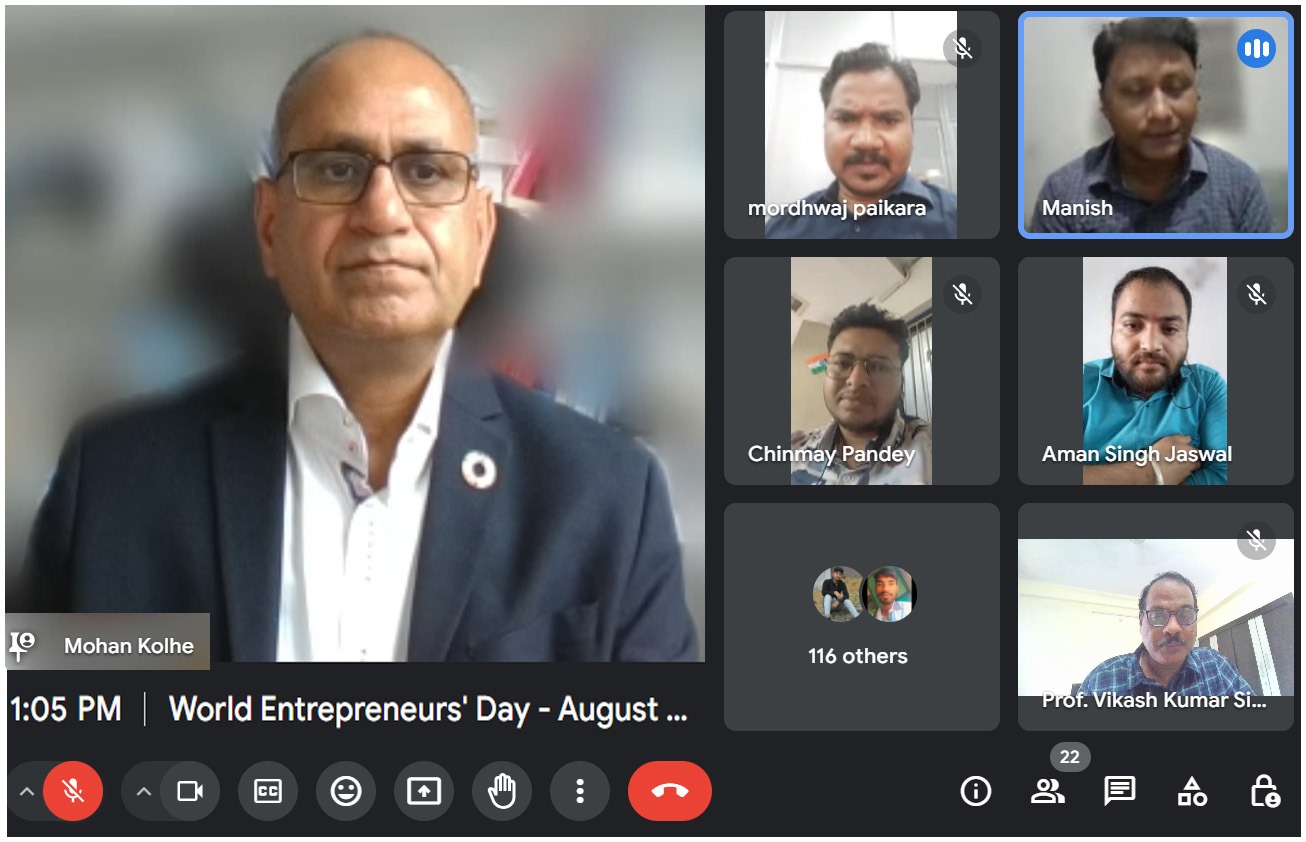
Anuppur, Under the aegis of Swavalambhi Bharat Abhiyan and Swadeshi Jagran Manch, social organization, Central University, State University organized an international discussion seminar on 21st August World Entrepreneurship Day through online medium. The chief guest of the program was IITN and University of Agder Norway Professor and Senior Scientist Prof. Mohan Kolhe.
Addressing the discussion seminar, Prof. Mohan Kolhe said that the basic mantra of developed India 2047 is entrepreneurship because entrepreneurship is the only option to provide employment to 37 crore youth seeking employment between the age of 18 years to 29 years and if the energy of these 37 crore youth is focused on innovation, quality and variety, then domestic and international trade worth 25 lakh crores will be created. In the National Education Policy 2020, major subjects like entrepreneurship, internship, apprenticeship have been included to provide livelihood and employment to the youth, it has become necessary to include local resource based innovation and MSME 4.0 in the curriculum. By making about 15000 types of products in about 37 different sectors not only for the domestic market of India but also for the global market and for the production of export quality products, the youth in the field of entrepreneurship will be able to give economic impetus to their future and the country.
Universities play an important role in leading the energy of 37 crore youth in the right direction. Prof. Mohan Kolhe further said that if entrepreneurship is established to provide employment to 37 crore youth, then India will definitely become the third largest economic power in the world in the next 3 years. Apart from this, various types of imports will have to be kept in mind to reduce imports. Especially in the field of energy, for bio CNG and bio LPG, a plant will have to be established in every district under the Govardhan Yojana, which can supply bio CNG to meet the LPG and diesel-petrol needs of that district. To exploit natural resources, every household should have energy self-rule and under the PM Suryaghar Free Electricity Scheme, the rural households should produce their own electricity and the energy used for pumping sets used in their fields or for the purpose of harvesting/threshing related to agriculture should be produced through solar energy and hydrogen energy, for this a detailed program will have to be run so that with the correct determination of energy self-rule, the import of crude oil and other gases can be reduced on a large scale. This will give India a great strength in economic development. Similarly, innovation should be done in different sectors where imports can be reduced and it should be included in the curriculum. By identifying different sectors such as pharmaceutical sector (active pharmaceutical ingredients), sports products, chemicals, textiles, yarn, food processing related items, innovative research and internships should be conducted with a view to reducing imports and increasing exports, this is at the core of the education policy.
National Education Policy 2020 is very important in making India a country of full employment. Prof. Mohan Kolhe, while giving a detailed explanation of the National Education Policy, further said that due to the correct formulation of NEP, the wrong notion of employment among the youth, that is, employment means government or private job or placement for a job, this notion will have to be changed. To change this, the students currently studying and the alumni will have to be given the right training to become entrepreneurs through internships, apprenticeships, entrepreneurship, innovation on local resources and they will have to be given idea generation and hand holding to become entrepreneurs, so that they can establish entrepreneurship wherever they are, keeping in mind their family and family enlightenment according to their ability, by being environment friendly. For this, there is a need for unprecedented change in the curriculum prescribed by the university, which is being felt very lacking. If the implementation of the National Education Policy is in accordance with the old education policy and the institutions will implement the National Education Policy just for the sake of showing off, then there will be no outcome from it. If the National Education Policy 2020 starts being misguided, it can become a big problem in the future. It is necessary that in this case, social institutions, educational institutions and industrial institutions together prepare a strategy for how to make youth and students entrepreneurs in accordance with the basic spirit of the National Education Policy 2020. Taking forward the mantra of 'Vocal for Local', important steps will have to be taken towards promoting exports through models like 'One District, One Product'. We have only one resolution - "Nation First, National Interest Paramount." Keeping this resolution in mind, a new and modern system will have to be included in the curriculum in all sectors of the country like tourism, MSME, education, health, transport and agriculture, so that self-employment opportunities increase. India will have to skill the youth for production in future technologies like semiconductors, artificial intelligence and other modern technologies. In the field of design, 'Design in India' and Bharat Green Hydrogen Mission and new energy sources will have to be included in the curriculum to motivate the youth to become entrepreneurs. These steps will play an important role in making India a strong and developed nation by 2047.
The subject of Panch Parivartan should be included as a compulsory subject in the curriculum
Prof. Mohan Kolhe further said that Panch Parivartan should be included as a compulsory subject in the curriculum of school education and higher education. Prof. Mohan said that for the development of any nation, it is also necessary that social harmony is established very strongly in that nation where there should be no place for concepts like casteism. For this, it is necessary that social harmony should be taught in the minds of every student from the beginning as both an experimental and theoretical subject. Pedagogical teaching learning is necessary to explain how important a family is and what can be the benefits of a joint family through Kutumb Prabodhan. Climate change is still a problem for the whole world, in such a situation, how can environmentally friendly work be done towards zero carbon emission, in this context a subject should be necessarily taught through pedagogical means. There should be comprehensive initiatives and curriculum for the indigenous lifestyle, indigenous feeling and self-awakening in the youth. Along with this, the task of inculcating civic duty, awareness of the duty of nation building and personality development in the youth should be carried out starting from school to higher education; for this, the Panch Parivartan should be included as a special curriculum. At the international level, the enlightened academic class of NRI India is preparing extensive pedagogical course material for this. Prominently present in the meeting were Acharya (Dr) Vikas Singh, Provincial Co-ordinator of Mahakoshal Province of Swavalambhi Bharat Abhiyan Swadeshi Jagran Manch and Dean of Central University Amarkantak, Dr Manish Taram, Head of Department of Pandit Shambhunath Shukla University, Chinmay Pandey, Head of Research Scholar of Youth Dimension of Swadeshi Jagran Manch, Mordhwaj Paikra, former Organization Minister of Akhil Bharatiya Vidyarthi Parishad and Swadeshi Jagran Manch's Mordhwaj Paikra, Geetesh Sao, Anurag Singh, Sandeep Gupta, Shivam Kumar, Shubham Gupta, Siddharth Gupta, Saurabh Manjhi, Rajiv Kissi, Khelan Orke, Omprakash Pathak, Pranali Borkar, Rachna Mishra, Ramsharan Prajapati, Rishabh Singh, Rituraj Sondhia, Harsh Soni, Ayush, Aman Singh Jaiswal, Swamitvar Sahu, Anuj Rajput, Anushka Yadav, Bhuvaneshwar Singh and many young students and professors.