
 India
India
 World
World
 Entertainment
 Sports
 Chhattisgarh
 Haryana
 Delhi
Delhi
 Religious
 Business
 Tech & Auto
 Education
 Health
 Andhra Pradesh
 Telangana
 Sikkim
 Odisha
 Jharkhand
 Assam
Assam
 Nagaland
Massive crowds gather for Ayatollah Ali Khamenei's final farewell
World's eyes on Iran amidst tight security
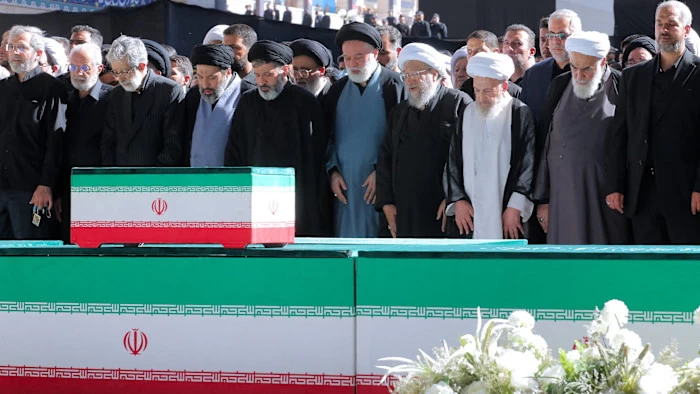
An unprecedented religious, political, and emotional atmosphere prevails across the country regarding the final farewell of Iran's Supreme Leader, Ayatollah Ali Khamenei. The mourning events, which began in the capital, Tehran, have now spread to several major cities, with the Iranian government presenting the occasion as a symbol of national unity and resistance. According to international media reports, thousands of people have thronged Tehran's Grand Mosalla complex, while claims suggest that tens of millions may participate in the week-long series of events; some government estimates project a turnout of between 15 million and 30 million people, although these figures could not be independently verified. Much of the discussion centers on why Khamenei's son—and the current Supreme Leader—Mojtaba Khamenei did not publicly attend the funeral rites. Iranian officials state that serious security threats concerning him have emerged in recent months, and his public appearances have been restricted due to fears of potential attacks backed by Israel and the United States. Consequently, Mojtaba Khamenei was kept away from the main public funeral activities, while his representatives and other family members formally participated in the events. The farewell proceedings are not limited to Tehran; in keeping with Shia tradition, processions and tribute gatherings have also been planned for holy cities such as Qom, Mashhad, and the Iraqi cities of Najaf and Karbala. The final burial is scheduled to take place near the Imam Reza Shrine in Mashhad, lending the event even greater religious significance. Iran had invited representatives from various friendly nations and allied organizations for the occasion; reports indicate that delegations from Russia, Pakistan, Iraq, Syria, Lebanon, Yemen, and several Central Asian countries have arrived in Tehran. Notably, there is high-level representation from Russia, as well as the presence of Pakistan's top leadership, Iraqi Shia leaders, and representatives linked to Lebanon's Hezbollah. On the other hand, the US, UK, France, and most Western nations did not participate, offering only formal condolences. Mixed sentiments are evident among the Iranian public regarding these events; government supporters view the occasion through the lens of national martyrdom and a spirit of resistance, with large crowds chanting slogans against US and Israeli policies and demanding retaliation. However, some analysts believe that a segment of society remains distanced from the government due to economic hardships and past protests, meaning the sentiment of the entire nation cannot be gauged solely by these massive gatherings. In terms of security, this is considered one of the largest operations in Iran's history; the Islamic Revolutionary Guard Corps (IRGC), the regular army, the police, and intelligence agencies have been deployed jointly. Additional security cordons have been established around key religious sites, airports, diplomatic compounds, and crowded areas. Anti-drone systems have been activated, and aerial surveillance has been intensified in sensitive zones to preempt any potential attacks or terrorist activities. US President Donald Trump has reacted sharply to these developments; in recent statements, he asserted that Iran's current leadership should recognize the extent of American power and hinted that the US possesses the capability to take action against the Iranian leadership. However, he ruled out immediate military action and did not entirely dismiss the possibility of dialogue. Trump's statements have further escalated tensions between the two nations. Internationally, the event is being viewed from diverse perspectives; in Russia, Pakistan, and various Shia-majority regions, it is regarded as a historic mourning ceremony and an expression of regional resistance. Conversely, Western nations and human rights organizations are focused on Iran's internal political transition, regional stability, and future power structure. Meanwhile, many experts believe this event serves not merely as a funeral but also as an opportunity to demonstrate the legitimacy and public support enjoyed by the new Iranian leadership. Ultimately, for Iran, this farewell represents more than just a religious ritual; it encompasses issues of national identity, political succession, and regional dynamics. It has become a historic moment involving the balance of power and international diplomacy, upon which the eyes of the entire world are fixed.