 India
India
 World
World
 Entertainment
 Sports
 Chhattisgarh
 Haryana
 Delhi
Delhi
 Religious
 Business
 Tech & Auto
 Education
 Health
 Andhra Pradesh
 Telangana
 Sikkim
 Odisha
 Jharkhand
 Assam
Assam
 Nagaland
EWS reservation will remain intact
SC's 5-judge bench gave its verdict by a majority of 3:2
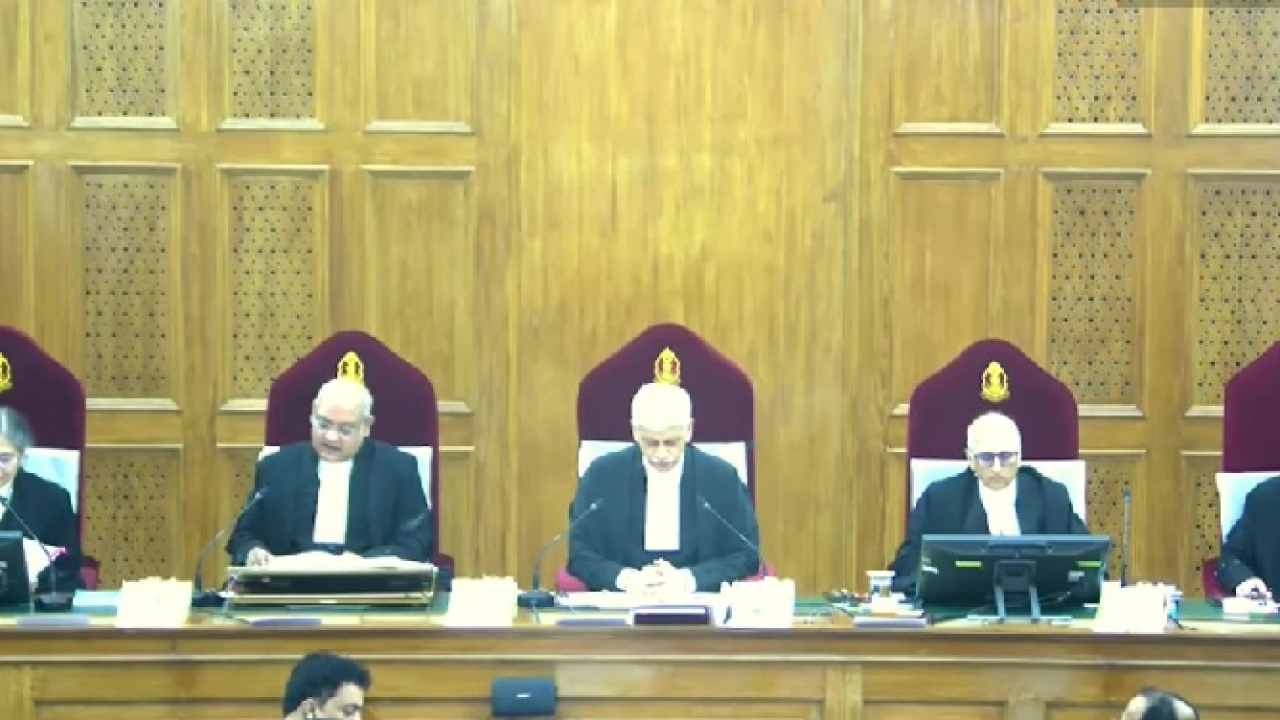
New Delhi, The Supreme Court today delivered its verdict on petitions challenging the validity of the 103rd Constitutional Amendment providing 10 per cent reservation to the Economically Weaker Sections (EWS) in admissions and government jobs. A five-judge constitution bench has upheld the validity of the 103rd Amendment Act, 2019 of the Constitution. The Constitution Bench of the Supreme Court, by a majority of 3:2, termed the system of giving 10 percent reservation to the economically weaker sections as constitutional. The constitutional validity of the EWS quota was challenged in the Supreme Court. After a long hearing on several petitions in this case, the top court had reserved its decision on September 27.
Justice Dinesh Maheshwari, Justice Bela M. Trivedi and Justice JB Pardiwala ruled in favor of EWS quota. These judges said that 10 per cent reservation for the economically weaker section does not violate the Constitution, while Justice S. Ravindra Bhat, disagreeing with the other 3 judges, termed this arrangement as unconstitutional. Chief Justice Justice UU Lalit also concurred with Justice Bhat and considered the EWS reservation to be unconstitutional. Let us tell you that today was the last day of CJI Uday Umesh Lalit in the Supreme Court. He is retiring today. Justice DY Chandrachun will be the next Chief Justice of India.
Which judge said what?
Justice Dinesh Maheshwari said, “The provision of 10 per cent reservation for economically weaker sections does not harm the Constitution in any way. This is not a violation of the Equality Code i.e. Equality Code. We have taken care of equality. Can economic quota be the only basis for giving economic reservation? Reservation is a means of affirmative action, so as to ensure the goals of an egalitarian society, it is a means of mainstreaming the deprived classes or communities. Reservation on economic grounds does not violate the basic structure of the Indian Constitution. The quota on economic grounds is not against the basic spirit of the Constitution.
Justice Bela M. Trivedi said, “If the states can justify it, then it cannot be considered discriminatory. The 103rd Constitutional Amendment is required as an affirmative action for the advancement of EWS sections. Equal classes cannot be treated equally. SC, ST and OBC have already got reservation. EWS reservation cannot be included in this. That's why the government gave 10 percent separate reservations. SEBC creates separate categories, which cannot be treated at par with the unreserved category. The benefits provided to the economically weaker sections under EWS cannot be called discriminatory. The petitions which were against the EWS quota failed.
Justice JB Pardiwala said, 'I agree with Justice Trivedi and Justice Maheshwari. EWS quota is correct. I uphold the 103rd Constitutional Amendment. Reservation cannot be allowed to become vested interests. It is a system to end social and economic inequality. This movement started 7 decades ago and the long-running development and education has helped in bridging this gap. Those who have become financially prosperous, have progressed, they should be removed from the backward class. So that the needy can be helped. There is a need to re-think the methods of determining backward classes so that this system is relevant in today's times. The protection should not continue indefinitely so that it becomes vested interest. Lastly, I uphold the #EWS amendment.'